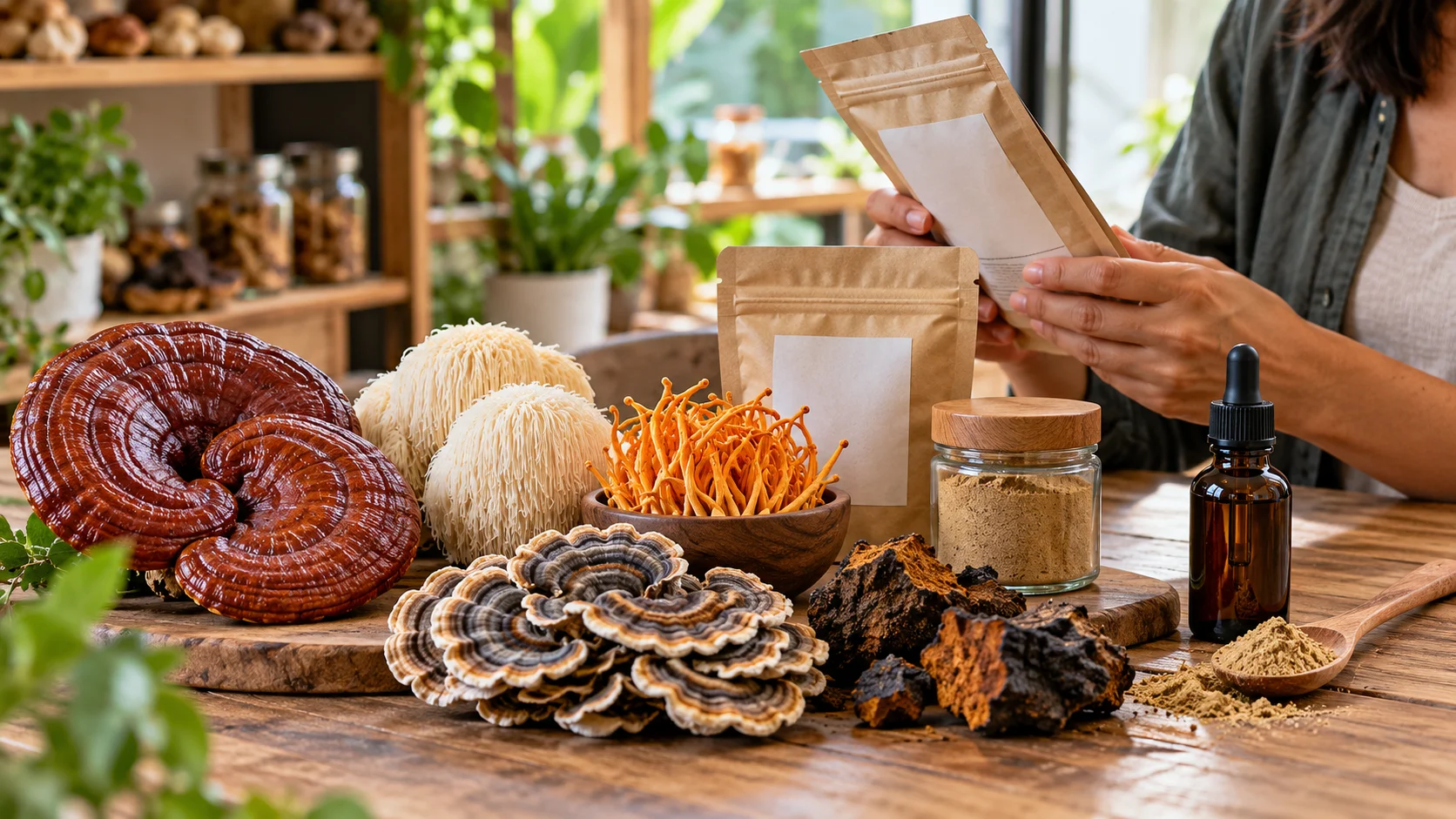
Pick up two mushroom packets and place them side by side. Both may show the same name. One contains plain powder. The other is a concentrated extract. Their prices are different, their labels use different terms, and neither packet makes the comparison easy. This is where most confusion around a medicinal mushroom begins.
So, forget the front design for a minute. Turn the packet around. Which species is inside? Was the fruiting body used, or the mycelium? How much do you get in one serving? A buyer who answers those questions is already making a better decision.
First, what does the term mean?
A medicinal mushroom is simply a fungus used in traditional health practices or studied for biologically active compounds. The description does not turn it into a prescription medicine. Nor does it prove that a capsule can treat a disease.
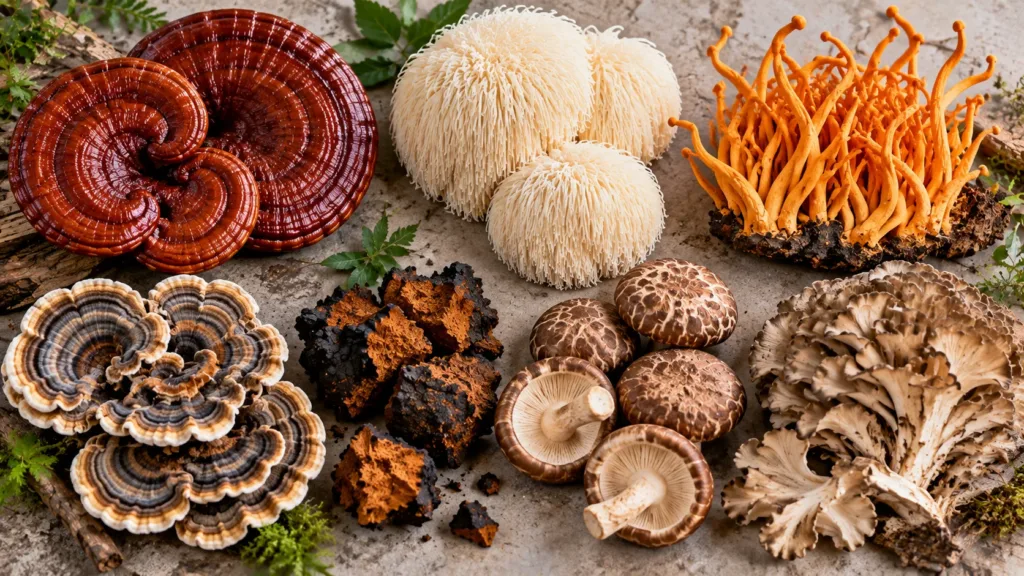
Some medicinal mushroom examples are also foods. Shiitake and maitake can go into a meal. Reishi, chaga, turkey tail, lion’s mane, and cordyceps are often seen in teas or supplements. The dividing line is not always neat, and that is fine. What matters is the product in your hand.
Here is a useful rule: treat the mushroom name as one piece of information. A trustworthy medicinal mushroom label still needs the scientific name, the material used, the serving amount, and basic manufacturing details.
The familiar names, without the hype
The table gives a quick starting point. It is not a treatment chart.
| Type | Why people buy it | Point often missed |
| Reishi | General wellness and traditional use | Extracts can differ greatly from tea or powder |
| Lion’s mane | Interest in memory, mood, and nerves | Early studies are not proof of a cure |
| Cordyceps | Energy or endurance claims | It may interact with diabetes or blood-thinning medicine |
| Turkey tail | Polysaccharides and immune research | A shop product cannot replace cancer care |
| Chaga | Tea use and antioxidant interest | Heavy use may bring a high oxalate load |
| Shiitake and maitake | Food value and beta-glucans | A cooked portion is not a concentrated extract |
Reishi is a good example of why form matters. Someone drinking a mild tea is not taking the same product as someone swallowing a concentrated extract. Research has examined reishi polysaccharides and triterpenes, but the findings do not support sweeping promises. A reishi medicinal mushroom product should never be sold as a guaranteed cure.
Lion’s mane attracts attention because researchers are looking at memory, mood, digestion, and nerve-related pathways. Interesting? Yes. Settled science? No. A small study cannot show that every lion’s mane medicinal mushroom supplement prevents dementia or treats depression.
Cordyceps brings another issue: identity. The name covers a group of fungi, while cultivated Cordyceps militaris is common in commercial products. Wild material is difficult to source. If you use medicine for blood sugar or clotting, discuss a concentrated cordyceps product with a healthcare professional first.
Turkey tail has been studied in specific preparations alongside medical care. That result belongs to the studied preparation; it does not travel automatically to every turkey tail powder. Chaga has the opposite lesson. Its compounds attract interest, but concentrated intake may create a kidney concern because of oxalates. A medicinal mushroom can have possible benefits and real limits at the same time.
Read research with one question in mind
Ask, “Was this result seen in people using the same product?” That question cuts through a lot of advertising.
Laboratory research on a medicinal mushroom may look at beta-glucans, polysaccharides, triterpenes, ergothioneine, or antioxidant activity. The work can help researchers understand what to study next. It cannot, by itself, tell you what will happen after a person takes a shop-bought capsule for three months.
Human medicinal mushroom trials help, but they also have limits. Some are small. Some are short. Others test a named extract that is not sold everywhere. If the dose, species, or preparation changes, the result may change as well.
Plain language is useful here. “May support” leaves room for uncertainty. “Guaranteed immunity” does not. A responsible medicinal mushroom article should never promise detoxification, cancer treatment, or a replacement for prescribed medicine.
Powder or extract: which is better?
Neither word guarantees quality. A medicinal mushroom powder may be close to the dried starting material. An extract uses water, alcohol, or both to concentrate selected compounds. The method can be useful, but only when the manufacturer explains what was done.
Look for the species, serving size, extract ratio where applicable, and fruiting-body or mycelium information. If a blend lists six mushrooms but hides every amount inside a “proprietary formula,” you cannot tell how much of each medicinal mushroom you receive.
More is not automatically better. Doubling a serving may raise the cost and the chance of stomach upset without adding a proven benefit. Follow the product directions unless a qualified professional advises otherwise.
A one-minute packet check
Before buying a medicinal mushroom product, slow down and check five things. This short habit is more useful than chasing the loudest claim.
| Check | Useful information |
| Identity | Common name plus scientific name |
| Material | Fruiting body, mycelium, or a clear blend |
| Serving | Actual amount and extract details |
| Traceability | Batch number, expiry date, and manufacturer address |
| Testing | Microbes, pesticides, heavy metals, and other contamination |
Independent testing can help confirm purity. It cannot prove that a medicinal mushroom cures a health condition. Certification and clinical evidence are not the same thing.
Buying and growing are different jobs
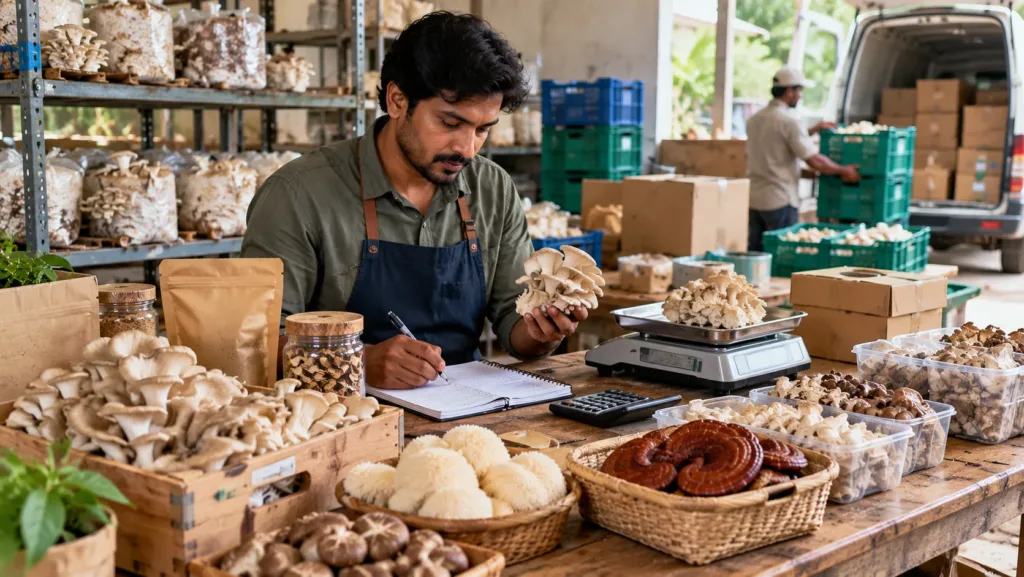
For a medicinal mushroom customer, the job may end with a packet. For a grower in India, the work begins much earlier: species, spawn, room, climate, hygiene, labour, and market.
A small project may start in a basic controlled space. A commercial medicinal mushroom project could need a production farm, spawn and culture laboratory, Cordyceps lab, or climate-controlled room. Button, oyster, reishi, lion’s mane, and Cordyceps do not all want an identical environment.
Before equipment is ordered, write down the crop, production target, site, budget, and intended buyer. Then consider temperature, humidity, airflow, clean movement of materials, and everyday operating discipline. Technical training and production records are not glamorous, but they keep a medicinal mushroom unit running after the setup team leaves.
Market planning belongs in the same conversation. A crop is not a business until quality, price, packaging, storage, transport, and demand work together. Avoid assuming that a buy-back or market connection is guaranteed unless it appears in clear written terms.
Who should be careful?
Many people eat correctly identified, cooked mushrooms without a problem. A concentrated medicinal mushroom extract is a different situation.
Possible medicinal mushroom reactions include stomach discomfort, headache, allergy, or changes in blood sugar. Reishi has been associated with nausea, bleeding concerns, and rare liver injury. Cordyceps may influence blood sugar or clotting. Chaga may not suit someone with kidney risk because of its oxalate content.
Seek professional advice before using a medicinal mushroom during pregnancy, breastfeeding, cancer treatment, or the period before surgery. The same applies if you have liver disease, kidney disease, an autoimmune condition, or regular medicines. Take special care with blood thinners, diabetes drugs, and immunosuppressants.
Quick questions
Natural does not mean risk-free. Species identity, contamination, concentration, dose, and medicine interactions all matter.
There is no universal first choice. For general nutrition, properly cooked food mushrooms may be simpler than a strong supplement.
They can be sold as blends, but mixing makes each dose and interaction harder to judge. Read every ingredient before using one.
The practical conclusion
A medicinal mushroom may be food, a supplement, a research subject, or a commercial crop. Those are four different contexts. Keeping them separate prevents exaggerated expectations. For any medicinal mushroom purchase, read the full label. Check the exact species and form. Look for realistic language, traceable manufacturing, and sensible safety advice. Most of all, remember that a medicinal mushroom belongs beside a balanced diet and proper healthcare—not in place of either one.

About author

Add comment